Tyler Seguin #19 of the Boston Bruins sports a Michael Jordan tongue as he stick-handles in the Winnipeg Jets’ defensive zone. Seguin has been a fantasy late round gem with 17 goals and 21 assists in 38 games played thus far. Seguin is only in his second year as a NHL professional, winning the Stanley Cup his rookie season with the Boston Bruins. Look at the bend of his right ankle in his Bauer Vapor APX ice hockey skates.
Posts Tagged Bauer Vapor APX
Photo of the Day
Jan 11
April 2012 will mark the release of the latest line of protective gear from Bauer Hockey. Below we have a great shot of the brand new Bauer Vapor APX gloves, APX shoulder pads, APX shin guards and APX elbow pads. The Bauer Vapor APX line of protective gear will pick up right where the X60 line left off, adding some new features as well.
Bauer’s Vapor APX glove has a great design to it, and looks like it will be a popular item. It’s going to provide a more snug fit than a 4-roll style glove, but still provide a bit of extra space for your hand. The APX shin guards and elbow pads look to carry a narrow profile, but still offer all of the protection you would expect in a pro level piece of equipment.
The Bauer APX shoulder pads, along with the shin guards and elbow pads, carry a very clean look. The various tones of grey, white and black go together very nicely, and the red accents add an excellent element of design to make them pop. Of course design isn’t everything, especially on protective equipment, and the APX series is sure to come up clutch where it really matters, protection.
Take a look at the new Bauer Vapor APX gloves, shoulder pads, shin gaurds and elbow pads below and let us know what you think. Is the Vapor APX line their best one yet?
Summer is here and it is hot outside. What better time than now to think about the nice and cold game of ice hockey? Even better, how about a new pair of skates? That’s just what I did and here is my first review of the Bauer Supreme One70 skate.
There are a lot of products out there when it comes to ice skates. Skates range in level of play, weight, look and feel, and, of course, price. The Supreme One70 happens to fall in that mid-price point for intermediate to advanced level play.
To me, fit is the most important part of a skate. This is, however, not to be confused with lower end skates that tend to have less support that allows the foot to move, instead of a moldable inside that truly holds your heel and foot in place. The Supreme line is designed for players with a wider toe box, in comparison to the Vapor APX having the traditional standard fit.
Level of play can be misleading when reviewing hockey equipment. At one end of the spectrum, we may think we are better than what we are, so does the top of the line skate really what we need? Or, perhaps we are getting into the game, so does that mean you should get the cheapest pair you can find? Choosing a mid-level skate not only offers some of the higher end technology and features, but it also offers the durability that we all love.
The specs on the skate are pretty dazzling when you read all that has gone into it. Hydrophobic grip liner, superfit footbed with stabilizer grip, and the list goes on. Simplifying the lingo, the skate is lightweight, has a good snug fit in the heal and a wider opening in the toe box than most skates, a durable fiber composite outside of skate, and a pretty sweet looking design.
The price point for some players may seem a little high at $299.99, but when you think about it, it’s not that bad. A skate should last you for at least two years, and you want something that does not hurt your feet, and something that feels like an extension of your leg.
My ice skating has been limited, still wrapping up a roller season. So far, I couldn’t be any happier. From the moment I tried on the Bauer Supreme One 70′s I knew they were the right ones for me. Like I said, how it feels on your foot is huge, and the Supreme One70 fits like a glove sock. As for performance, as Matt also noted with his new pair of CCM U+10‘s, with higher end skates you can really feel the transfer of energy from your stride to the ice. This is because of the stiffness of the boot. Overall, I’m happy with my purchase and look forward to putting it through some testing to see what exactly I am capable of doing with the skate. Hopefully a few sick dangles.
Interested in the technology put into Bauer hockey skates? Check out our interview with Ken Covo, Bauer Senior Director of Research and Development.
Recently we had an opportunity to hold an interview with the Senior Director of Research and Development at Bauer Hockey, Ken Covo. The main topic of our conversation was, of course, the latest and greatest from Bauer Hockey: the Vapor APX skate. But, in addition to the new skates, we also had some other great questions for Ken. Read on for part one of our interview.
Hockey World Blog: Can you tell us a little bit about the processs involved with designing a new line of skates? For example, how long a normal product cycle is (from research, design, to the release of the product)?
Ken Covo: Sure, I can give you a rough idea. It’s approximately 18 months is the cycle the development cycle so once we decide that we are going to need to design/develop a specific family of skates or particular model in that line-up of skates it usually starts with a briefing process approximately 18 months before the product actually gets out into the market place. The one thing there is that occassionaly, depending on the product, sometimes there will be elements of the product that actually have been in development longer – they might have been on an advanced development timeline and then finally reached a point where they were ready to be incorporated into a product so they will be brought in during that 18 month cycle.
HWB: When you set out to develop the new APX skates, what was your goal?
KC: We felt that we could actually bring the performance level of the Vapor skate up just based on things we had seen in our development projects for other skates. But at the same time, we were talking, with the X:60, about a skate that was pretty successful. So, we wanted to be very sensitive to the “if it aint broke, don’t fix it” kind of thing. But internally we really felt that, because of the technologies that were available to us, that we had learned a lot about over the last, I’d say five years, our 3D forming technology being the main one that im talking about, that it would be possible to preserve the things about the X:60 that players like but at the same time bring that performance level up a notch.
HWB: What type of testing gets done on a new product, such as the APX skate?
KC: It’s pretty extensive. It starts out with lab testing on specific materials and components before they’re even part of an actual skate. Then, once we start getting to the stage of producing prototypes at the factory, then we’re talking about being able to bring those products out into actual usage through our field testing group. We also continue to do various lab tests on a finished skate but ,the key thing is, as soon as we can we get the skates out on to players, get their feedback and they fill out questionaires. It’s a very rigorous process.
The questionaires are designed according to what the objectives were for that particular development project. So a product like the APX skate went through numerous iterations and it actually ended up being one of the most heavily tested skates that I’ve ever seen in my 16 years here just because we wanted to be so careful to respect the aims and objectives of the design project in terms of preserving the basic fit that people have come to expect from the Vapor skate and at the same in working with this new process and material being brought over to the Vapor line we had to double, triple, quadruple check all aspects of durability so we were building up hours on the skates and tracking them and bringing them back in. Our field testing guys did a fantastic job of coordinating available testers. One of the tricky things is that when we’re going through all that extensive development process testing, we’re talking about sample size skates so they’re basically a size 8 skate. So we have to build up a whole database of size 8 players of various calibers and in this case mostly decent/high caliber hockey players that are also capable of giving us good feedback. And by good feedback it’s like honest feedback – whether its good news or bad news – that plus looking at the skates ourselves.
So the story of the APX skate was quite amazing because at various points our field testing guys were literally driving to one arena and dropping off the skate while a guy did a practice in the skate and then collecting the skate afterwards and driving to another arena and giving that skate to another player so that we could build up hours and sufficient hours on the skate to be confident on how it was going to hold up.
HWB: Can you give me an example of some of the questions that might appear on your questionaires?
KC: Sure. If a skate is designed and we’re expecting an improvement in acceleration, lets say, which is the case with the APX skate, it was designed for quick take-off through the lightness and the stiffness basically, we sort of felt that we were going to try to hit that balance between light weight and support that would make this skate good for take-off. Well, then one of the questions is going to be ‘What’s your perception of your ability to take off and accelerate in this skate?’ Those are performance related questions, but we’ll also have fit and comfort related questions. We’ll have a map of the skate and ask if anyone notices any hot points or anything like that and we look for patterns basically if we hear from a significant percentage of our testers that they’re all feeling a hot point or pressure point in a particular spot on the skate then we’ll obviously take a look there and maybe do some modifications to the last – or the foot form that’s used to create the volume for the skate – and that way we collect all the information that we think we need to really fine tune the development.
HWB: What does the APX skate offer that a top end skate from your competitors does not have?
KC: Well, we’re 100% confident in the performance side of it, that top level players will put on this skate and skate with it and feel that it meets all their needs in terms of, like I said before, that balance of light weight and support. You can make a skate really light if you want, but you can lose on durability or on support. So that’s why when we’re going through the testing we make sure that we’re asking all the questions and not just certain ones. So performance we’re really confident in.
We’ve had great feedback from all of our testers about the fact that they enjoy wearing the skate and no hesitation about playing in a key game or anything like that with the skate. The guys really gave us positive feedback on that. And, as I said, we think we’re delivering that performance without sacrificing durability. We’ve put so many hours of testing into this skate, we’re confident that we’re not going to have an issue that should have been caught. If there’s anything thats going to happen out in the marketplace, we’ve done enough testing that we would have seen it.
HWB: These skates are designed for a high-end player, one that can skate pretty well. For your every day player, why should they purchase the APX skates over another model – especially at the price point?
KC: That’s a great question. I’m the R&D guy, probably the product management guys would have a good answer for you. But I can tell you from my own experience, as a player, I mean I still play a lot of hockey myself, I’m in my old-timers dressing room so this kind of question comes up when I’m talking with the guys and it all boils down to how important a player feels about his performance and what I’ve seen is that it doesnt matter what level of hockey you’re playing. Some guys just really care about getting everything on their side in order to be able to play hockey as well as they can. And I see that on my old timers team. There will be guys who do whatever they do during the day but when game time rolls around – even if they’re only playing once or twice a week - I think this is very typical of all hockey players that I know – they want to be as good as they possibly can be. And if they believe a certain product is going to help them do that, then that makes them interested in that product.
HWB: From your perspective, was there any concern with sales numbers – with either the Total One or the APX – when you introduced the higher price point skate?
KC: Well, I was participating in various meetings where the subject came up and, yeah, I think there were people who defintely at least posed the question about whether consumers would be scared away by having the top price where it is. Again, I think it boils down to a high degree of confidence that, really, at that price players were getting their money’s worth and so that’s what really propelled the decision to go forward with it.
HWB: Did sales of the Total One skate play any role in that? I mean, seeing the success of that skate, did you guys have a little more confidence knowing that a Vapor line skate along the same level would sell pretty well?
KC: My feeling is yes, although I haven’t been involved in too many of the meetings where the actaul decision was taken about where to put the price point, but I would say that you’re right in that the experience with the Total One made a difference in the final decision.
Check back soon for part two of our interview with Ken Covo. We’ve got some more good questions and a lot of really great information on Bauer Hockey and their skates.
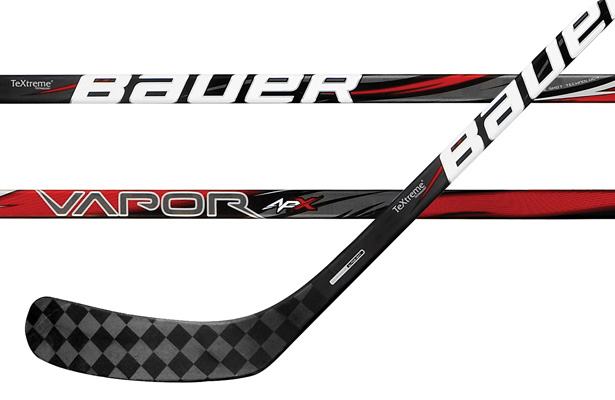
Bauer Vapor APX Hockey Stick
Mar 24
Update: Head over to Pure Hockey to pick up your Bauer Vapor APX hockey stick! Enter the coupon code “hockeyworld” to save 10% on select items.
After the successful release of the Bauer APX skate, we knew it wouldn’t be long before a stick by the same name followed. Well, following the typical Fall release pattern for new sticks, we can expect to see the Bauer Vapor APX hockey stick hit retail store shelves in October of 2011.
More information is now coming out about the new Bauer Vapor APX hockey stick, and we’ve got some technical specifications to share with you. Some of the features you can expect on the Bauer Vapor APX hockey stick are outlined below:
“The Bauer Vapor APX hockey stick has been designed to have optimal balance and a quick release. It is ideal for the crafty player that excels in puck handling and quick-release shots.” – Bauer Hockey 2011 Holiday Catalog
Micro Feel II Shaft – The shaft will have rounded corners and double concave walls to allow you to get that comfortable feel and fit in your hands.
Intelli-Sense Shot Technology – The APX stick is designed with a dual kick point. Prior to 2009, Vapor sticks had a low kick-point which provided a quick release on wristers and snap shots. With the addition of a higher kick point, the Bauer Vapor APX stick can now provide a great kick on slapshots as well.
Patented Dual Density Blade Core – Similar to the blade of the Total One, the dual density blade core is the ultimate combination of balance, feel, power and performance. The blade contains an aramid reinforced epoxy core, which provides that tremendous feel for the puck upon receiving a pass or while stick handling. Additionally, the Aero Foam II core material will prevent blade deflection when shooting by providing torsional stiffness. This will increase accuracy and improve overall blade balance.
The Bauer Vapor APX hockey stick will come in both grip and clear version. The APX Griptac stick will feature a bit of white on it, where the clear APX hockey stick will be more black, grey and red. The traditional clear APX stick is definitely looking better in to me. I’m still sticking with my opinion that the APX stick is the best looking stick Bauer has ever designed.
The new stick will, of course, come in senior, intermediate and junior sizes. Each size will feature varying flexes and blade patterns. Retail stores will begin shipping the new Bauer Vapor APX sticks in October, so you won’t have to wait too long to get your mitts on one.
You can now buy the new Bauer Vapor APX hockey stick from Pure Hockey for $249.99.
Update 4/29/11: The Bauer APX skates are now available for purchase, and ready to ship! Head over to Ice Warehouse now to buy your Bauer APX skates.
Update 12/10/10: We finally have a picture of the final version of the Bauer Vapor APX skates. A lot of people are complaining about the look, saying they like the x60 better. Personally, I think the APX skates look sick. The biggest downfall, as with the Total One, is going to be how expensive these skates are. As some of our commenters have pointed out, you can expect these skates to cost $800. They’ll hit retail store shelves in April 2011.
Within the past couple days, a couple pictures have been leaked of a prototype version of the new Bauer Vapor APX ice hockey skates. These skates look the be the successor to the Bauer Vapor X:60. There is no telling if the graphics on this prototype will be the same as the production version, but they look pretty slick.
Check out the pictures below and let us know what you think!


